IBBC 2025

Lisbon will host the International Conference on Bioenergy and Bioeconomy (IBBC 2025), organized in partnership with ISEC Lisboa and the IEA-IETS Task XI Committee on Industry-Based Biorefineries Towards Sustainability. Under the theme “Shaping the Future of Bioenergy and Bioeconomy”, the event will gather global experts to discuss cutting-edge innovations, policy frameworks, and technological solutions for advancing a sustainable bio-based economy.

The conference program includes keynote sessions, technical talks, workshops, and exhibitions, offering participants opportunities to share knowledge and engage in discussions on the benefits and challenges of bioenergy and bioeconomy. These concepts are central to reducing fossil fuel dependence and addressing climate change, while continuing to promote economic development.

More info here.

ECCE/ECAB 2025

The next ECCE/ECAB will take place together with CIBIQ in Lisbon/Portugal on 8 – 10 September 2025.

Chemical engineering, biotechnology and bioprocessing are the key to providing innovative solutions for food supply, mobility, energy, health and well-being while striving for a sustainable economy. At ECCE 15 & ECAB 8, scientists from industry, universities and research institutions from Europe and beyond will meet in Lisbon to discuss the latest research and industrial applications in all fields of chemistry, process engineering, biotechnology and related fields.

This year’s conference will be held in conjunction with the 3rd CIBIQ – Iberoamerican Congress on Chemical Engineering. The CIBIQ congresses were born with the goal and the spirit of building bridges within the Ibero- American, chemical engineering community to join forces, to work as a team, to share experiences, and to attain even higher goals for the benefit of the Society that we serve.

The conferences unite chemical and process engineers, biotechnologists, bioprocess experts, chemists, material scientists and related disciplines with a focus on applied research and development.

ESCAPE 35

The 35th European Symposium on Computer Aided Process Engineering (ESCAPE) will be held between July 6 and July 9, 2025 at the Technology Campus Ghent, KU Leuven as a part of KU Leuven’s 600th year celebrations. It will be organised jointly by KU Leuven and University of Liege. 

The ESCAPE series is an annual series initiated in 1991 by the CAPE Working Party of the European Federation of Chemical Engineering. The 2025 conference theme “Closing the loop 2.0” emphasises on use of process systems engineering (from “good old feedback control” to advanced methodologies using AI, quantum computing, etc.) to accelerate the drive towards a circular economy with applications in energy, life sciences, and materials domains. 

ICCDU 2025

Under the theme “CO2 for a Circular Economy”, ICCDU 2025 will follow the success of the previous annual editions of ICCDU series, in providing a vital platform for exchanging knowledge, innovative approaches, and driving pioneering solutions and sustainable technologies to accelerate the drive towards an effective circular carbon economy.

ICCDU 2025 aims to play a crucial role not only in disseminating the results of innovative cutting-edge research approaches for CO2 capture and utilization, but also in showing that in the present moment several of these approaches and solutions have reached high levels of maturity and TRLs through pilot-scale and real industrial-scale applications. The focus is on harnessing the power of science and technology to develop sustainable pathways for using carbon dioxide in various industries for production of energy, chemicals, materials, and fuels.

ICCDU 2025 will be held at the Congress Center of IST-University of Lisbon in the city’s center.

ICCDU 2024

ICCDU is the premier conference in the global research community of CO2 utilization including CO2 capture and CO2 conversion, CO2 utilization without conversion and emerging topics related to hydrogen energy, climate change, as well as and techno-economical and policy aspects. This annual conference insures its international nature by its International Scientific Committee (ISC) consisting of senior scholars in the field from many Asian, European and American countries and by rotating the venue between Asia, Europe, and America. The ICCDU 2024 conference follows ICCDU 2023 in Bari, Italy, and ICCDU 2022 in Princeton, USA.

ICCDU 2024 in Dalian, China will provide a great platform for scientific discussion and exchange of basic scientific information for promoting CO2 capture and CO2 utilization to mitigate global Climate Change and promote sustainable development. Very important progresses have been achieved, and regional and national initiatives have been recently launched in many countries around the Globe. It would also be useful to international community to see the research activities and type of research and development in CO2 capture and utilization as well as industrial R&D and commercialization efforts in China in 2024. This is because the researchers in China have become very active in CO2 utilization area, since the Chinese government launched 30-60 Dual Carbon Goal in 2020 [Carbon (CO2) Peaking by 2030 and Carbon Neutrality by 2060], and remarkable progresses have been achieved in research, development and commercialization in the past several years. ICCDU 2024 will serve as a multi-disciplinary forum, offering a valuable opportunity that allows us to contribute to and develop a better understanding on the state of the art in CO2 utilization research worldwide and to meet with friends and professional colleagues from man y parts of the world.

34th ESCAPE

The joint Symposium combining the 34th European Symposium on Computer -Aided Process Engineering and the 15th International Symposium on Process Systems Engineering (PSE) will be held in Florence, Italy on June 2-6, 2024.

The PSE series of triennial conferences was initiated in 1982, rotates between venues in the Americas, Asia-Pacific and Europe and has proved to be an attractive global platform for PSE academics, researchers, and practitioners from all corners of the world to share advances in PSE education, research, and application.

The ESCAPE series is an annual series initiated in 1991 by the CAPE Working Party of the European Federation of Chemical Engineering which is convened at sites rotating through the member countries of the European Federation.

A joint symposium occurs in the years when the PSE rotation brings the event to Europe. The 2024 Symposium is only the fourth time that this joint event has been held (Copenhagen 2015, Garmisch-Partenkirchen 2006 and Trondheim 1997) and will combine the innovative PSE research conducted in Europe with exciting PSE developments occurring on a global scale.

The keynotes, presentations and discussions will extend over 4 stimulating days and will cover the progress made in the broad range of the methodologies of the PSE toolkit, including AI, data analytics and digitalization, as well as impactful applications in the energy, food, healthcare, materials and sustainability domains. The venue in Florence, one of the premier cultural centers of Europe, will also provide the opportunity for participants to further enrich their understanding, appreciation and enjoyment of the fine arts and cuisine of Italy.

Focus on Non-technical Barriers and Drivers for Industry Transition

On February 22, 2024 the Mission Innovation Net-Zero Industries Mission (MI NZI) and the IETS TCP jointly hosted a workshop focusing on non-technical barriers and drivers in the journey toward industry decarbonisation. The workshop was well received with 70+ participants from over 15 countries.

Acknowledging that non-technical factors play a crucial role in industry decarbonisation, the workshop places a specific emphasis on these aspects. These non-technical factors can be “external”, such as power prices, policy instruments, and infrastructure, which cannot be directly controlled by industry actions. Conversely, “internal” non-technical factors are within the realm of industry influence. The workshop aimed to focus on “internal” aspects, sharing experiences and lessons learned to catalyse new tasks within the IETS TCP. Aspects discussed included new business models for commercial viability, system integration and interplay between technologies, stakeholder cooperation (industry, academia, consultants, public authorities), scaling up from pilot to full-scale, workforce development, legal aspects and time planning challenges and public acceptance. (+ info here)

37th IETS ExCo Meeting

The meeting was kindly hosted by Instituto Superior Técnico in Lisbon, Portugal, which also organized a site visit to the Navigator Industrial Complex in Setúbal in connection to the meeting.
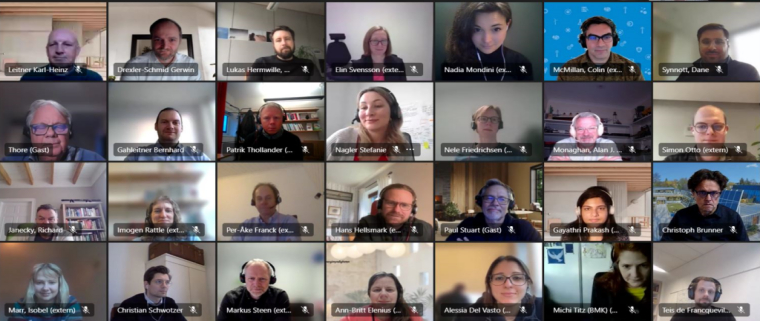
ExCo members (delegates and/or alternate delegates) from eight member countries, a representative from the IEA Secretariat, most Task Managers and the IETS Secretariat staff participated in the whole or parts of the meeting. Task Managers, a representative from the IEA Secretariat and some delegates/alternates attended the meeting online.
The theme for the preceding workshop together with the GNIP group was “Workshop on Energy Efficiency and Related Projects with Portuguese Experts”. (+ info here)

ICCDU 2023

In 1986 and 1989 I was the organizer and co-ordinator of two NATO (North Atlantic Treatise Organization) Schools, namely “CO2 as source of carbon” and “Enzymatic and Model Carboxylation and Reduction Reactions for CO2 Utilization”, respectively, aimed at creating a contact between skilled young researchers and experts from different areas, such as chemistry, industrial processes, plant physiology, biochemistry, biotechnology, microbiology. The Schools were attended by close to 100 young scientists and the lectures delivered were collected in two books published by Reidel and Kluwer, respectively. Such two events boosted Junior Researchers mobility and Senior Researchers collaborations. It was during the 1989 School, that with two Japanese colleagues attending it, Kaname Ito and Tomoyuki Inui, decided to organize in 1991, within a Conference on Catalytic Syntheses in Nagoya, a Session dedicated to “CO2 chemical utilization” and I was invited as plenary speaker there. The Conference gathered mainly Asian colleagues with a very few from EU and USA. During the above-mentioned Conference, talking to Ito and Inui we agreed on the opportunity of setting a continuing event that could gather the “CO2 community”. The real first ICCDU was organized in Bari-IT in 1993, were we recognized the two Schools and the 1991 event in Nagoya as the nest of the Series and considered the Nagoya Conference as ICCDU-I.

In Bari, ICCDU gathered some 220 scientists from all over the world (34 Countries were represented) confirming its real international character. The International Scientific Committee of ICCDU was set that gathered all prominent scientists in the chemical, industrial and microbiological areas. The ISC named me as Permanent Secretary, and took the decision of organizing a biennial event, visiting, in turn, the three main geographical areas where CO2 utilization was developing: Europe, Asia, and America.

ICCDU was started and moved around the world as shown below.

I held the Chair position until 2013, when ISC suggested that it was time to designate a younger Colleague: Prof. Chunshan Song from PennState was named Chair with Prof. Angela Dibenedetto, University of Bari, as Vice-Chair. The ISC named me Honorary Chairman. Starting 2015, ICCDU was organized on an annual basis, considering the growing number of scientists working in the CO2 area all over the world.

ICCDU has had the great merit of keeping cohered the worldwide scientific community working in the area of CO2 conversion, mainly the chemical part, while the community of biochemists, physiologists and microbiologists made waving appearance, depending on the venue where the Conference was organized. ICCDU covers today a large number of topics spanning from biological fixation, homogeneous and heterogeneous catalysis, electrochemistry, carbonation of waste, hydrated CO2, Life Cycle Assessment, Integrated Processes, CO2 enabling/sustainable processes.

The series of ICCDUs, location and Organizer(s): I) Nagoya, JP K. Ito 1991; II) Bari, IT M. Aresta 1993; III) Oklahoma, USA K. Nicholas 1995; IV) Kyoto, JP T. Inui 1997; V) Karlsruhe, DE E. Dinjus 1999; VI) Breckenridge, USA D. D. Darensbourg and D. Dubois 2001; VII) Seoul, SK K.-W.Lee and S.-E. Park 2003; VIII) Oslo, NO R. Heyn 2005; IX) Kingston, CA P. Jessop 2007; X) Tianjin, CN C.-J. Liu 2009; XI) Dijon, FR D. Ballivet 2011; XII) Alexandria, USA C. Song 2013; XIII) Singapore, SG S. Kawi and I.Karimi 2015; XIV) Sheffield, UK P. Styring 2016; XV) Shanghai, CN Y. Sun 2017; XVI) Rio de Janiero, BR C. Mota 2018; XVII) Aachen, DE W. Leitner and D Kraemer 2019; XVIII) Daejeon, SK J.Lee and SE Park 2021; XIX) Princeton-USA A Bocarsly 2022 ; XX Bari, A. Dibenedetto.

33rd ESCAPE

The ESCAPE conference series accounts for essential and vital events that enjoy strikingly international audiences bringing together active members of the Process Systems Engineering community worldwide. The series started in 1992. Since then, the events have been hosted by most European countries including twice in Greece in earlier years (Rhodos: 1996, Porto Carras: 2011). Due to COVID-19 the series had to run as virtual events recently (Milano 2020, Istanbul 2021). They successfully returned to normal, face-to-face meeting in 2022 (Toulouse, France). For more details on the ESCAPE-series visit the CAPE Working Party website.

ESCAPE-33 anticipates emerging and significant challenges in Process Systems Engineering as these relate to the sustainable development of chemical processes, the development and the systematic evaluation of processing technologies and process innovations, and research promoting circular economy paradigms including social aspects and social engagement networks to incentivize and involve citizens. ESCAPE 33 recognizes particular importance to industrial biotechnology as a driver and enabler for new chemistries, alongside data engineering as a technological challenge with an apparent impact on many systems technologies.

It is anticipated that this conference would attract a significant number of people from academia, research institutions, and industrial organizations. The symposium, including several networking activities, would cover the most up-to-date topics related to Process Systems Engineering. Presentations given by distinguished European and other world-renowned plenary and keynote speakers would offer a cutting-edge to the symposium. The event will be coordinated with guided visits to major archeological sites and museums, cultural events in Athens, including options to attend theatrical performances at the Herod Atticus Odeon, and guided tours of the monuments that marked the contemporary face of Old Athens.